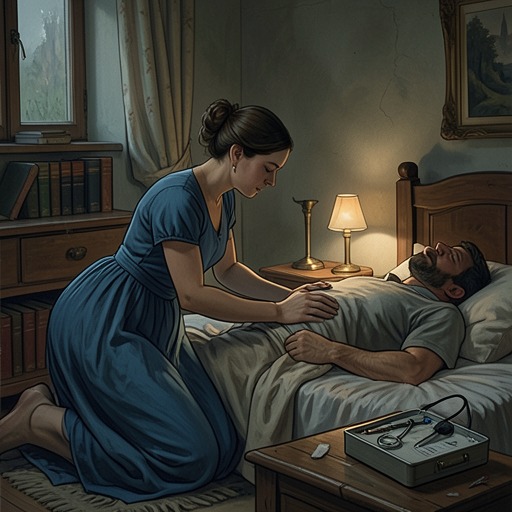
Chernobyl-style death
Voices from ChernobylChernobyl-style death is the name Lyudmilla Ignatenko’s testimony gives to a death that appeared unlike any she had known: her husband Vasily Ignatenko’s body changed before her eyes, care became an intimate daily labor, and fear followed him from the sickroom into the rituals of death. Her account does not turn that experience into a settled medical explanation. Instead, it records what she saw, what others refused to face, and the uncertainty that remained when the funeral was over.
A death without an explanation
Lyudmilla describes a divide between naming the disaster and understanding it. People could say and write Chernobyl, she observes, but no one knew what it was. For her, the rupture reached beyond one diagnosis: “we aren’t born the same, we don’t die the same.” The phrase frames the death not as an isolated medical episode but as an experience that unsettles ordinary expectations of birth, illness, and dying.
After the doctors told her that the tumors had spread upward along Vasily’s body rather than inward, the changes gathered on his face and neck. His chin seemed to recede, his neck disappeared, his tongue fell out, and veins swelled as he began bleeding from his neck, cheeks, and ears. Lyudmilla pressed cold water and wet cloths to him, but could not stop the bleeding; she remembers the sound of it striking a washbowl as peaceful and rural, a sound that still returned to her at night. The familiar domestic setting could not make the illness familiar.
The changes also altered their means of communication. After Vasily could no longer speak or even whisper, they used a notebook and pencil. When he asked for a mirror, Lyudmilla avoided giving it to him for two days, pretending not to understand. On the third day he wrote the request in large letters with three exclamation points. Her evasion reveals a painful conflict: she feared that he would see what had happened to his face, while he insisted on seeing it for himself.
Care at home and the fear around it
Vasily was sent home with a special needle, and Lyudmilla learned to feed him through it. Four times a day she cooked fresh food, ground it in a meat grinder, and passed it through the needle into the tube that reached his stomach. He had lost his sense of smell; when she asked how the food tasted, he could not tell. The task made care precise and repetitive, while the small question about taste preserved a form of ordinary closeness between them.
They sometimes went to the movies and kissed there, trying to return to life while treating Chernobyl as a forbidden subject. Lyudmilla intercepted phone calls because Vasily’s fellow brigade members were dying one by one, and she did not want him to hear. He did not know that he was the last from his brigade still alive. When he could no longer get up or speak, his fear became visible to her in his widened eyes.
The surrounding medical response offered little security. Ambulance workers knew the couple and sometimes did not want to come, saying there was nothing they could do. When one young doctor recognized that Vasily had gone to Chernobyl, he cried out that he had seen how those men died and wished the end would come quickly. Vasily was conscious and heard him. A nurse from a nearby clinic refused to enter the room. Lyudmilla, by contrast, stayed and improvised: when Vasily yelled in pain, she used a syringe filled with vodka to make him lose consciousness, a method other women had shared with her. The contrast makes isolation part of the dying: those who feared the sight withdrew, leaving the person closest to him to do what she could.
The last year and the final encounter
Lyudmilla says there was one year left after Vasily’s sudden loss of speech, and that he spent it dying, worsening day by day. He was forty-five. During the last weeks, even using a half-liter can to urinate took half an hour; he kept his eyes lowered, ashamed. Yet their intimacy continued. He called for her at night, and she remembers that desire remained between them even as his daytime appearance made the extent of his illness difficult to comprehend. She recalls nursing and caressing him, and the earlier moments of their life together, including his return from Kamchatka with a beard and a birthday spent on a park bench.
His suffering was not only physical. As he became mute, the notebook carried practical instructions as well as what he could not say aloud. He wrote that when he died she should sell the car and spare tire, and that she should not marry his brother, Tolik. On his last day, after weeks of decline, he opened his eyes, sat up, smiled, and called her “Valyushka.” He died alone later that morning. Lyudmilla stopped the clocks in the house at seven.
The certificate his fellow workers brought sharpened the gap between public commemoration and private loss. It came in a red folder bearing Lenin’s photograph. Vasily covered himself with a blanket so that only his hair showed while the men stood beside him. He had become afraid of people; Lyudmilla says she alone did not frighten him. The certificate’s official image and the dying man’s withdrawal occupy the same room without resolving into a single meaning.
After death: fear, remains, and testimony
At the burial, Lyudmilla covered Vasily’s face with two handkerchiefs and lifted them when people asked to see him. One woman fainted. The orderlies from the morgue asked for vodka and told her that they had seen many terrible deaths, including people injured in accidents and children caught in fires, but nothing like the way Chernobylites died. Their reaction echoed the doctor’s: the body had become an object of fear even for people accustomed to death. Lyudmilla also recalls that, according to custom, relatives were not supposed to wash and dress their dead, yet the necessary handling of Vasily’s body and the reactions of those around it made ordinary funeral practice feel inadequate.
Rumors that the dead remained radioactive extended that fear beyond the body. Lyudmilla had read that the graves of Chernobyl firefighters who died in Moscow hospitals, buried near Mitino, were still considered radioactive, and that people avoided burying relatives nearby. Vasily had asked her to burn his remains so she would not be afraid. His protective white suit remained in the family’s storage space until his death; although Lyudmilla wanted to keep it, her mother feared it, and the family took his belongings outside town and buried them. The suit thus joined the dead man’s possessions in a second burial, shaped by the danger the family could neither verify nor dismiss.
After the cremation, Lyudmilla was not afraid to touch the urn. She felt something small inside, like seashells in sand, and recognized the fragments as his hip bones. She also describes seeing a little puff of smoke beside him after his death and again at the crematorium, which she understood as his soul; no one else saw it. The account holds that perception as her own, alongside the material remains and the rumors of radiation. Chernobyl-style death persists in that unresolved conjunction: a body altered by illness, a survivor’s vivid witness, and a world in which neither official names nor familiar customs could make the experience fully knowable.